Tag Archive 'time'

Jul 12 2010

Profile Image of Walt

These Summer Days

Filed under Blog Post

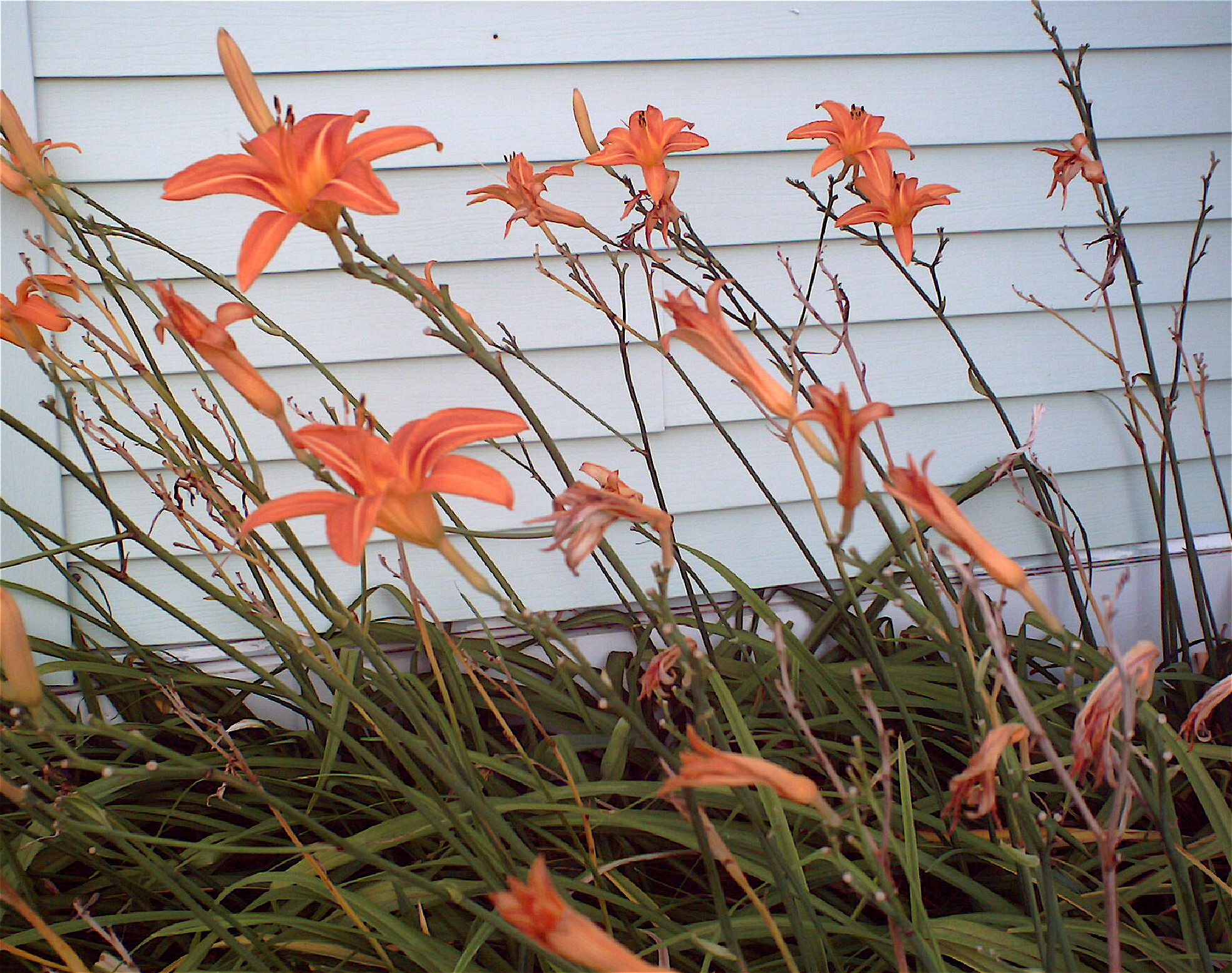
Nothing symbolizes these summer days in Vermont better than day lilies.  They are big, bright, cheery flowers, no less beautiful for being commonplace.  They grow all over the place this time of year: in front of humble homes like mine, along roads and lanes, in uncut fields with daisies, black-eyed Susans and other wildflowers, and in carefully cultivated gardens.  This morning, while walking a logging road, I even saw a patch of them in a clearing deep in the woods.  Yeah, this time of year, they seem to be everywhere.

Wild or domestic, good soil or poor, they are herbal phalanxes that shout vitality.  They are equal to any insult or injury, as anyone who has dug up their complex network of roots and rhizomes will attest.  So bring on the heat waves, bugs, droughts, torrential downpours, or anything else that summer can throw at them.  They are ready.  They are strong.

But day lilies do not last forever.  While this tight knot of plants may bloom a month or more, each individual flower lasts only a day.  Hence the name.  The bud opens in early morning, shouts floral joy into world all day long, then withers at dusk.  Surely some of them must bloom two days or longer, but I haven’t seen it.  I don’t despair, though.  There are still plenty more buds to open.  There are still plenty more days.

Yeah, day lilies are physical manifestations of the summer season that launch themselves into the world around the Summer Solstice, and then gradually fade with the gradual shortening of daylight.  Like summer heat, they seem relentless, overbearing, unending. . . but their days pass much sooner than we expect.  So if you’ll excuse me, I’ll sign off now.  The day lilies are marking time, and there is still so much I want to do this summer.

Comments Off

Jun 07 2010

Profile Image of Walt

Walking the Beach

Filed under Blog Post

Judy and I took our annual trip to the Maine coast last week.  Per usual, we rented a cottage overlooking a salt marsh.  The view out the cottage window is very comfortable for a woodsy guy like me – all wetland and forest.  But there comes a time when it’s best to crawl out of one’s comfort zone and see the world in a different way.  So early one morning I hiked the half mile access road to Goose Rocks Beach then walked along water’s edge, taking it all in.

On a misty, gray-sky day, the ocean horizon is indistinct, suggesting infinity.  Waves break towards shore, wearing down all conventional notions of time.  I walked the beach, all too aware that my boot prints would soon wash away.  Impermanence.  Only the ocean itself remains fixed in place – a vast body of water stretching beyond imagination.  And yet it too is constantly moving, constantly changing it’s mood.

The beach is covered with oceanic debris.  Long rows of aquatic vegetation mark the tide’s high water line.  And mixed into it shells, fragments of shells, the body parts of crabs and lobsters, and countless other organics in various stages of decay.  Much like the forest, the shoreline reeks of decay – repulsive to my landlubber nose at first, then oddly sweet and inviting as I recall from whence I came.  The ocean is the wellspring of all life on this planet.  Nowhere is that more apparent than on the beach when the tide is going out.

Sandpipers and plovers fed along the shoreline.  Sand fleas cued them to the most scrumptious morsels.  I skirted a tidal pool that seemed like a buffet to some of the shorebirds.  A gull carried off something.  Just off shore, ducks and eiders dove for breakfast.  Much like the forest, the shoreline ecology is all about food.

Funny how my gaze always starts on the horizon and ends up in the sand at my feet.  I looked for things of interest among the shoreline deposits without knowing how such things are valued.  I found a sand dollar, picked it up, then found another, then another.  The currency of the ocean wild.  My wife values them, anyhow.  So does my granddaughter.  I picked up a particularly interesting shell and stuffed it in my pocket.  I’m not sure why.  What the ocean coughs up is hard to resist.

The waves continued breaking in my head as I hiked back towards the cottage, away from shore.  Even now, days later, I can still hear it.  In my mind’s eye, I can still see the foamy edge of the sea washing over the sand, leaving fresh deposits there.  Nature’s watery hand is never still.  What am I to make of this?  Perhaps it’s best if I make nothing of it at all.  Tabula rasa.  Each new wave wipes the slate clean.

Comments Off

Jun 15 2009

Profile Image of Walt

The Passage of Time

Filed under Blog Post

Last week I hiked up Bamforth Ridge.  Stretching six miles from the Winooski River to the top of Camel’s Hump, this ridge is the longest, hardest base-to-summit climb in Vermont.  I figured it would be a good place to train for my upcoming Maine trek – a good place to test my limits, that is.  On that count I wasn’t disappointed.

I puffed halfway up the ridge before the hike became difficult.  Then I pushed myself another mile uphill, overcoming gravity by sheer force of will until reaching an exposed knob with a nearly 360-degree view.  Good enough.  I broke for lunch with the summit still looming large in front of me.  Then I turned back.

Going uphill was relatively easy – just a matter of will.  Going downhill was another matter.  Knees don’t lie.  With each step they reminded me that my strongest hiking days have passed.  A walking stick helped, but there’s no getting around the physical reality of a half century of wear and tear, as much as a forever-young Baby Boomer like me wants to deny it.

Yesterday I finished reading a book by Lester Brown called Eco-Economy.  It’s a rehash of his somewhat Malthusian notions concerning the limits of growth – concepts that I first encountered back in college in the 70s.  Industrialization and population are outpacing food production and other natural resources.  No big news there.  But what bothered me is just how little progress we’ve made during the past thirty-odd years.  Well into the 21st Century now, we’re still having the same eco-arguments.  Meanwhile, the math worsens and collective human misery keeps rising.  Being that I belong to the sixth of humanity that’s on top of the heap, I probably shouldn’t worry about it.  But I do.

My grandson, Mason, came to me the other day wearing a green bush hat and said with a great big smile:  “I’m just like you, Grandpa!”  I nodded my head, acknowledging that he is.  Mason loves being outdoors.  When he was three, he cried when his Mommy made him go back inside.  At five, he’s ready to plunge deep into the woods, to take on the world.  Soon he’ll be on the trail with me.

I still have work to do.  I don’t know how but somehow I have to help break the deadlock that exists in human affairs.  Old arguments, polarized stances and antiquated worldviews must be abandoned in favor of something that actually works – something that will make the world a better place for all the Masons out there.  The time has come to be pragmatic, meet enemies halfway, and get things done.  Thirty years of the same old eco-arguments, for chrissakes.  Talk is cheap.

Bamforth Ridge kicked my ass, but I’m ready to do it all over again.  I’m ready for another big hike.  I’m still moving despite the passage of time.  Hard to say whether my kind and I will ever get anywhere, but we’re moving all the same.  No sense stopping.  And when we’re done, Mason and his generation will carry on.  Why shouldn’t they?  Time passes, but it’s never too late to take on the world.

Comments Off

Nov 17 2008

Profile Image of Walt

View from the Hill

Filed under Blog Post

Midday.  Matika and I stretch our legs.  There’s a light flurry of snow falling, which is probably why we have the hill all to ourselves today.  The forest is mostly shades of brown and gray.  Matika cavorts about the open woods, looking for a chipmunk or squirrel to terrorize.  She occasionally finds one rummaging about the leaves.  I ignore her for the most part as I amble up the trail.

Halfway up the hill, I detour to the lookout for a quick view of St. Albans.  The town sprawls before me like a model railroad layout.  The collective hum of cars coming and going contradicts the stillness of the greater panorama.  Beyond the edge of town, farm fields and woodlots stretch to Lake Champlain and its islands.  Beyond the lake, mountains rise into low clouds.  A squall to the west blocks the northernmost edge of the Adirondacks from view.  The cold wind brings tears to my eyes.  I turn away from the lookout and slip deeper into the woods.

While climbing the last rise to the summit, I wonder how many more times I’ll hike this hill before I tire of it.  There’s no way to know, of course.  There’s only this eternal present.  Deep in it now, I realize that I come here more for a sense of perspective than anything else – a quick fix of the wild when I haven’t the time or inclination to drive an hour or so to the mountains.  A week, a day, or only an hour in the woods, I take what I can get.

I cross over the summit ridge, then catch the view eastward from the nearby ski slope.  More cars race along the interstate below.  I turn away, deliberately cutting my pace to make the downhill half of the hike last as long as possible.  I have work to do but am in no big hurry to get back to it.  Matika chases a squirrel up a tree.  I call her back to my side.

On the way back to the car, I pass the remnant of an old, dead tree still protruding twenty feet into the air.  I’ve been passing it for years and can’t help but wonder when it’ll come down.  Someday it’ll drop.  It’s just a matter of time.  Chances are good that I won’t be walking past it when it does, yet fallen trees litter the forest floor.

It seems like everything is a function of time and scale.   “Time is cheap and rather insignificant,” Thoreau once wrote in his journals, “It matters not whether it is a river which changes from side to side in a geological period or an eel that wriggles past in an instant.”  A walk in the woods, even a short one like this, drives this point home.

The roof of my house is visible from the lookout on the hill.  So is the cluster of buildings downtown where I run my errands.  The better part of my life is visible from up there, though I rarely think about it as I go about my daily affairs.  Someday I’m going to sit up there and ponder things for hours on end, or so I keep telling myself.  But I can never sit at that lookout more than twenty minutes before growing restless, thinking about all the things I should be doing.  That, I find, is the essential paradox of a good view.

Comments Off